If you’ve spent any time this year searching BigCommerce vs Shopify, you’ve probably noticed something strange: the two platforms suddenly look a lot more alike than they used to. In fact, after BigCommerce’s June 2026 pricing overhaul, both companies now charge nearly identical monthly rates at every tier. As a result, the old shortcut, “pick BigCommerce if you want lower fees, pick Shopify if you want more apps,” doesn’t hold up the way it used to.
That doesn’t mean the two platforms are the same, however. Instead, the differences that matter now are more specific: how each one handles growth caps, payment processing, and what happens after someone actually buys from you. Below is a plain-language breakdown of where BigCommerce and Shopify stand today, plus the one question neither platform is built to answer.
Quick answer: In 2026, BigCommerce and Shopify charge almost identical monthly prices, so the real decision comes down to sales caps, payment fees, and app ecosystem size, not the sticker price. BigCommerce tends to suit high-volume sellers who want more native features and fewer apps; Shopify tends to suit sellers who want an uncapped platform and the largest app marketplace. Neither one solves customer retention on its own.
BigCommerce vs Shopify Pricing in 2026
As of BigCommerce’s 2026 pricing overhaul, the entry-level plans on both platforms cost the same: $39/month paid monthly, or $29/month billed annually. That pattern continues up the tier list.
| Plan Tier | BigCommerce | Shopify |
|---|---|---|
| Entry | Core: $39/mo | Basic: $39/mo |
| Mid | Growth: $105/mo | Grow: $105/mo |
| Advanced | Scale: $399/mo | Advanced: $399/mo |
| Enterprise | Performance: from $1,499/mo | Plus: from $2,300/mo |
However, the sticker prices match while the fine print doesn’t. BigCommerce caps how much revenue you can process on each plan before it pushes you to upgrade: $30,000 in trailing twelve-month sales on Core, $100,000 on Growth, and roughly $33,333 per month on Scale before overage fees kick in. Shopify, on the other hand, doesn’t impose sales caps on any plan, according to Shopify’s current pricing page. That means you can process any volume on the $39 Basic plan, though you’d likely outgrow its feature set long before you’d outgrow the limit.
Payment processing is the other place the two diverge. BigCommerce charges $0 in additional fees when you use one of its “embedded” payment providers (Stripe, PayPal, Adyen, and similar), regardless of plan. Route payments through an outside processor instead, and you’ll pay 2.0% on Core, 1.0% on Growth, or 0.6% on Scale. Shopify’s standard card rate through Shopify Payments, meanwhile, runs 2.9% + 30¢ on Basic, dropping to 2.5% + 30¢ on Advanced, plus an extra 0.5-2% surcharge if you skip Shopify Payments for a third-party processor.
Bottom line on pricing: if you process high volume and use each platform’s native payment tool, BigCommerce’s fee structure is friendlier. If you want zero risk of hitting a revenue ceiling, Shopify’s uncapped model removes that worry entirely.
Features and Ease of Use: Where They Actually Differ
That said, price parity doesn’t mean the platforms solve the same problems equally well.
Shopify wins on onboarding and ecosystem size. Its app marketplace dwarfs BigCommerce’s, which matters if you plan to bolt on specialized tools for shipping, subscriptions, or personalization rather than build them yourself. In addition, new sellers tend to find Shopify’s setup flow faster to learn, since so much documentation and third-party support already exists for it.
BigCommerce, however, tends to win on native functionality. Features that require a paid app on Shopify, like advanced product filtering, multi-currency, or B2B pricing tiers, are often built into BigCommerce’s higher plans out of the box. For example, that’s appealing if you’d rather not manage a growing stack of monthly app subscriptions, in line with the “run your business from one platform instead of ten” logic that drives a lot of platform-switching decisions in the first place.
Here’s what to weigh depending on how you operate:
- If you rely heavily on apps and integrations, Shopify’s larger marketplace reduces the odds you’ll hit a wall.
- If you want more native features without stacking apps, BigCommerce’s higher tiers pack more in by default.
- If you’re processing high volume through your own payment processor, compare the fee percentages above line by line. Even a 0.5% difference adds up fast at scale.
- If you’re brand new and unsure what you’ll need, Shopify’s documentation and support volume generally shortens the learning curve.
So, Which One Should You Choose: BigCommerce or Shopify?
Ultimately, there isn’t a universal winner. If your business is a simple online store selling through a website and occasional email or ad campaigns, either platform will support you competently in 2026, and the decision often comes down to which app ecosystem or native feature set matches your specific catalog.
A few other practical differences are worth checking before you commit. For instance, BigCommerce includes multi-storefront tools and more robust B2B pricing natively on its higher tiers, which matters if you sell wholesale alongside retail. Shopify’s point-of-sale hardware and in-person checkout, in contrast, tend to be more polished if you also sell at markets, pop-ups, or a physical location. Neither difference is dramatic enough to override everything else on this page, but if either applies to you, it’s worth weighing more heavily than the pricing table alone.
However, all of that is also exactly where a lot of sellers get stuck asking the wrong question. Comparing BigCommerce and Shopify assumes the platform itself is what determines whether customers come back. In reality, neither platform was built to solve retention. They’re built to process transactions well. What happens between the first sale and the fifth one is left almost entirely up to you.
The Question Neither Platform Answers: What Happens After the Sale
This is the part that gets lost in most BigCommerce vs Shopify comparisons: a storefront platform’s job ends at checkout. Whether a customer comes back a second time depends on how engaged they were before they bought and how easy you make it for them to return, and that’s a retention problem, not a hosting problem.
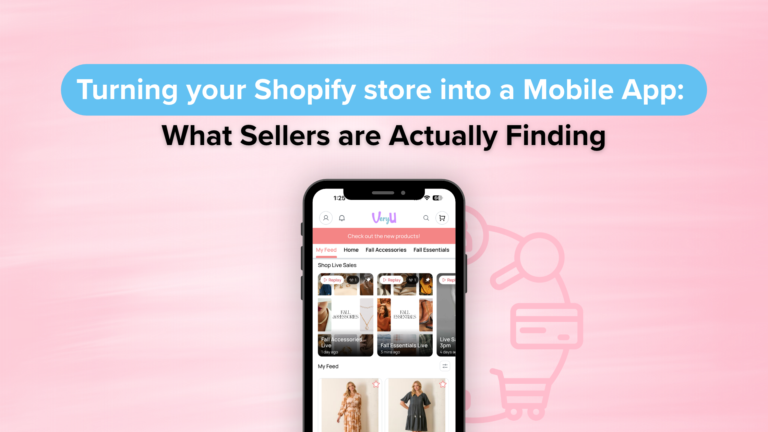
Consider the numbers. Online shops that add a branded mobile app see 60% of first-time app shoppers return to buy again. Similarly, sellers running live selling see conversion rates between 9-30%, compared to 2-3% on a typical storefront. Neither of those outcomes comes from choosing the right ecommerce backend. Instead, they come from building direct, ongoing engagement with the people already following you on social media.
That’s the gap CommentSold is built to close, either as your full platform or layered on top of the storefront you already picked. If you’re running on Shopify today, you can sync your Shopify store with CommentSold and add live selling, a branded mobile app, and automated fulfillment without rebuilding your catalog from scratch. As a result, the “which platform” decision stops being the whole story. It becomes one piece of a bigger question: what turns your followers into repeat customers, no matter which storefront powers the checkout page.
Frequently Asked Questions
Is BigCommerce or Shopify cheaper in 2026? They’re nearly identical on sticker price after BigCommerce’s 2026 pricing update, with matching $39/$105/$399 monthly tiers. The real cost difference shows up in payment processing fees and, for BigCommerce, in the revenue caps that can trigger an upgrade sooner than expected.
Does Shopify have sales limits like BigCommerce? No. Shopify doesn’t cap how much revenue you can process on any plan. BigCommerce does, with thresholds ranging from $30,000 in trailing twelve-month sales on its entry plan up to a monthly GMV cap on its Scale plan.
Which platform has more apps and integrations? Shopify’s app marketplace is considerably larger than BigCommerce’s, which makes it the easier choice if your growth plan depends on adding specialized third-party tools over time. BigCommerce narrows that gap somewhat by building more functionality, like advanced filtering and B2B pricing, directly into its higher-tier plans instead of requiring a separate app.
Can I add live selling or a mobile app to Shopify or BigCommerce? Yes. Neither platform includes live selling or a branded mobile app natively, but both problems can be solved without switching your storefront. CommentSold connects to your existing store to add live selling, a branded app, and retention tools on top of the platform you already use.
Do I need to choose between CommentSold and Shopify or BigCommerce? No, and for most established sellers, it isn’t an either/or decision. CommentSold is often added alongside Shopify to handle the parts of the customer relationship, like live selling, push notifications, and repeat-purchase behavior, that a general storefront platform isn’t designed to manage.
If you’re comparing BigCommerce vs Shopify because growth has stalled and not because of a checkout bug, the fix probably isn’t a new backend. See how CommentSold works and find out what’s actually driving repeat purchases for sellers who look a lot like you.