If you’re selling on Instagram in the morning, checking app notifications at lunch, and still logging into three different dashboards to figure out what actually shipped, you already know the problem. Growing across channels should mean more sales, not more manual work. Even knowing the best time to post Instagram Reels can help you reach your audience when they’re most active, but managing content and orders across multiple platforms still takes time.Instead, it often means more spreadsheets, more logins, and more chances for something to fall through the cracks. The right omnichannel tools fix that by connecting live selling, your mobile app, and your website into one system instead of ten disconnected ones. Below are the seven you need in place in 2026, whether you’re scaling a resale shop, launching a new product line, or moving into a category you’ve never sold in before.
What “Omnichannel Tools” Really Mean for Scaling Sellers
Omnichannel tools are the software and integrations that let a retailer sell, fulfill, and communicate with customers consistently across every channel, live video, mobile app, website, and social, without re-entering data or managing separate systems for each one. For a small team, that consistency is what makes scaling possible. Without it, every new channel you add multiplies your workload instead of your revenue. With it, adding a channel just means adding another place for the same inventory, the same customer profile, and the same order to show up correctly.
That distinction matters more as retailers expand into new product categories and audiences. A seller moving beyond their original niche can’t afford to rebuild their tech stack for every new vertical. They need tools built to flex.
1. Live Selling With Real-Time Conversion
Live selling remains one of the highest-converting channels available to online retailers, and it’s the clearest example of why omnichannel tools matter. Traditional storefronts convert at roughly 2–3%. Live selling converts at 9–30%, according to CommentSold’s own platform data, because shoppers can ask questions, see products in motion, and buy in the moment instead of adding to a cart they’ll abandon later.
The catch is that live selling only works as an omnichannel asset if the sale connects immediately to your inventory and your other channels. A comment-to-cart flow that updates stock everywhere, not just on the livestream, is what turns a single broadcast into a channel you can scale rather than a one-off event.
2. A Branded Mobile App That Keeps Shoppers Coming Back
If your only presence is a website or a social profile, you’re relying on shoppers to remember to come back. A branded mobile app removes that friction. 60% of first-time mobile app shoppers return to buy again, which makes the app one of the strongest retention tools available to a growing retailer.
For sellers expanding into new categories, the app is also where customers experience the brand as a whole, not just one product line. Push notifications, saved payment info, and a consistent look and feel do more to build loyalty than another discount code ever will.
3. A Video-First Website That Feels Like an Extension of Your Feed
Shoppers who discover you on TikTok or Instagram expect your website to feel similarly dynamic, not like a static catalog from a decade ago. A video-first website, one that surfaces short clips, replays, and product demos the way your social feed does, keeps that momentum going instead of letting it drop off the moment someone clicks through.
This is also where omnichannel tools quietly do their best work. A shopper who watched a live sale, opened your app the next day, and finally checked out on your website should never feel like they’re dealing with three separate businesses.
4. Social Commerce Integrations for Facebook, Instagram, and TikTok
Visibility on social media isn’t the hard part anymore. Converting that attention into a sale is. Direct integrations with Facebook, Instagram, and TikTok, paired with tools like automated comment replies, close the gap between someone seeing your product and actually buying it.
In fact, the retailers who treat social as a true sales channel, not just a marketing one, are the ones best positioned for the shift toward social-first shopping happening across every category, not just fashion resale.
5. Unified Inventory Management Across Every Channel
Nothing kills a scaling retailer’s momentum faster than overselling an item because live sales, app orders, and web orders were pulling from three different counts. Unified inventory management solves this by tracking stock in real time across every channel from a single source of truth.
This becomes non-negotiable as you add channels or move into new verticals with different product types. A system built for one category should still hold up when you add another, whether that’s expanding from apparel into home goods or from resale into new product lines entirely.
6. Automated Fulfillment and Invoicing That Scale With You
Manual invoicing and fulfillment work fine at a small scale. However, that manual work becomes the bottleneck the moment order volume grows across multiple channels. 80% of successful online shops already use automation to keep pace, according to CommentSold platform data, because automated invoicing and fulfillment free up hours that would otherwise go to repetitive backend tasks.
That time matters most for teams without a dedicated operations department. Automation isn’t about replacing people. It’s about making sure the two or three people running the business aren’t buried in tasks a system could handle instead.
7. Customer Insights and Segmentation That Follow the Shopper Everywhere
A shopper’s behavior on live video, in your app, and on your website should build one profile, not three disconnected ones. Customer insights and segmentation tools that follow the shopper across channels let you send the right offer, the right restock alert, or the right win-back message based on their full history with your brand, not just their last touchpoint.
This is where loyalty actually compounds. According to Omnisend’s omnichannel retail research, brands with strong omnichannel engagement retain 89% of their customers, and retailers using three or more connected channels see engagement increase by as much as 250% compared to single-channel sellers. Segmentation is what makes that kind of consistency possible without a full-time analyst on staff.
Why Omnichannel Tools Work Better as One Platform Than a Patchwork
Most retailers don’t end up with ten disconnected tools on purpose. It happens gradually: a live selling app here, a separate inventory system there, a checkout plugin bolted onto a website that was never built for video content. Each tool solves one problem while quietly creating three more integration headaches.
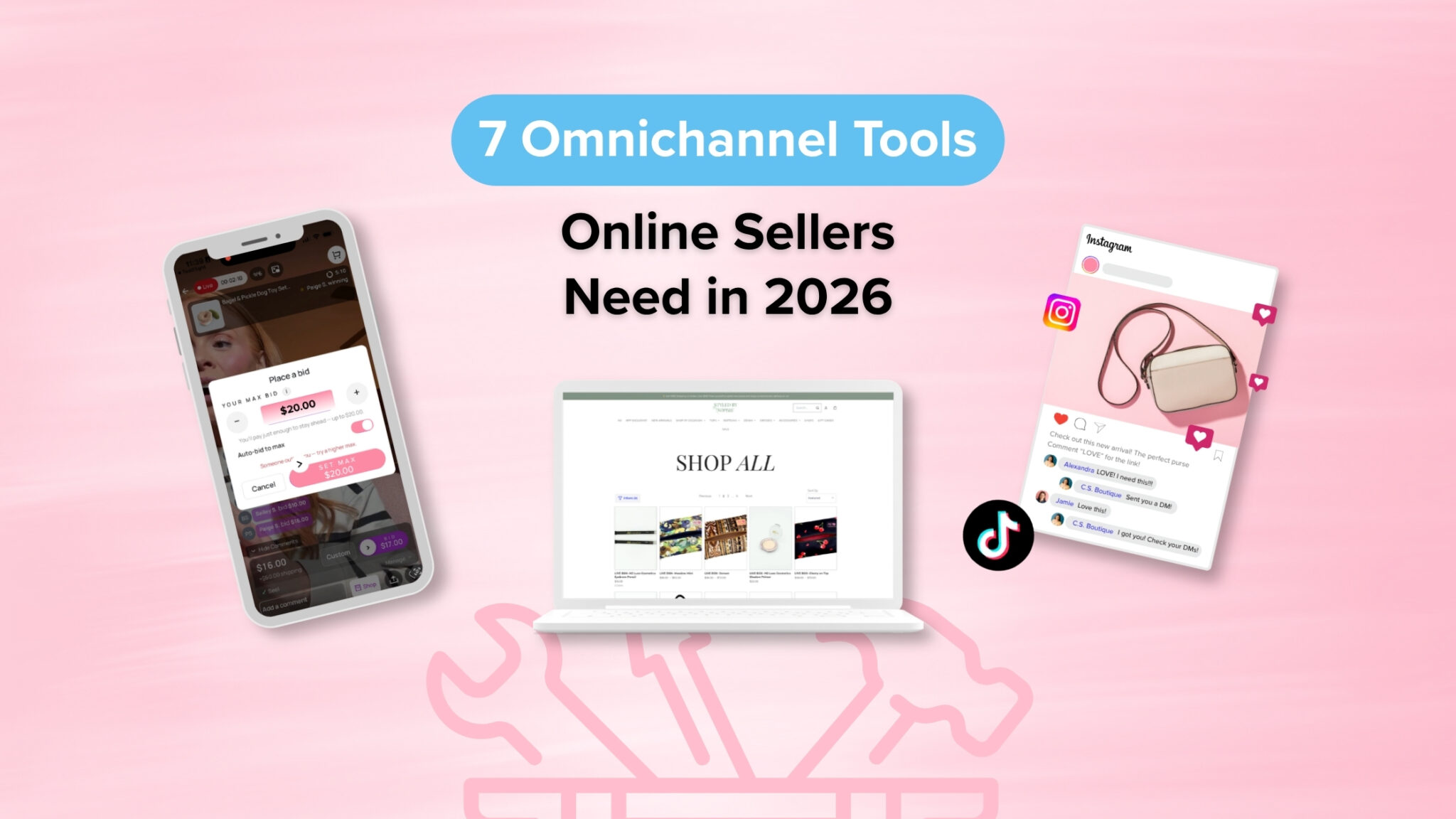
CommentSold’s live selling, branded mobile app, and video-first website run on one connected platform instead. That means the omnichannel tools covered above aren’t separate products you have to stitch together. They’re one system, which is exactly what makes it realistic for a small team to manage. This matters even more for retailers expanding into categories outside their original niche, since a platform built for that flexibility can publish live replays across your website and mobile app without extra engineering work on your end.
Frequently Asked Questions
What are the most important omnichannel tools for a small online retailer? The essentials are live selling, a branded mobile app, a video-first website, social commerce integrations, unified inventory management, automated fulfillment, and customer segmentation. Together, these seven omnichannel tools cover discovery, conversion, retention, and the backend operations needed to support all three without extra manual work.
How do I sell the same products across live, app, and web without doubling my workload? The key is a shared inventory and order system that updates in real time across every channel, rather than separate tools for each one. That means when an item sells during a livestream, the count of that item drops everywhere else automatically, which is what unified inventory management is built to handle.
Is it worth adding a mobile app if I already sell on social media and my website? Yes, for retention specifically. Social media and websites are strong for discovery, but a branded mobile app is what brings shoppers back on their own. With 60% of first-time app shoppers returning to buy again, the app closes a retention gap that social and web alone typically can’t.
Can I add omnichannel tools without switching my entire platform? It depends on the tool and how it’s built. Point solutions often require separate logins and manual syncing, which adds work instead of removing it. A platform designed around live selling, app, and web from the ground up lets you add channels without rebuilding your operations each time.
Do omnichannel tools make sense for sellers moving into new product categories, not just fashion? Yes. The retailers seeing the most success expanding into new verticals are the ones whose backend, inventory, fulfillment, and customer data, doesn’t have to be rebuilt for every new category. Omnichannel tools that were designed to be category-agnostic scale with the assortment instead of limiting it.
Ready to Stop Managing Channels Separately?
Scaling shouldn’t mean adding more logins, more manual counts, and more room for error. If you’re ready to run live selling, your app, and your website from one connected platform instead of a patchwork of tools, see how CommentSold works and find out what an actual omnichannel setup looks like for your business.