Choosing an enterprise ecommerce platform feels different once a brand outgrows a plug-and-play storefront. The demo calls start to blur together, every vendor claims to be “all-in-one,” and the real question (will this actually grow revenue, not just process orders) gets buried under feature checklists. Most platform comparisons focus on checkout speed and payment processors, but that’s not what determines whether a platform earns its price tag two years in. What actually matters is whether the system helps you keep the customers you already have while making it easier to reach new ones. Below is what experienced retailers look for before they sign a contract, along with the questions that separate a platform that scales with you from one you’ll be migrating away from again.
What Is an Enterprise Ecommerce Platform, and Why Has the Definition Changed?
An enterprise ecommerce platform is the operational backbone a growing brand uses to manage sales, inventory, fulfillment, and customer relationships across every channel at scale. Unlike a basic storefront builder, it needs to support higher order volume, more complex catalogs, and integrations that a smaller shop never has to think about.
That definition used to stop there. Historically, “enterprise” meant a handful of big, expensive systems built for traffic volume and little else. Today, the definition has expanded, and a modern enterprise commerce platform also needs to handle social selling, live commerce, and retention, because that’s where growing brands are finding their next round of revenue. In other words, scale isn’t just about how many orders a system can process. It’s about how many of those customers come back.
The 6 Things to Look for in an Enterprise Ecommerce Platform
Feature lists can make almost any platform look impressive on a slide. What matters more is whether these six things are actually built in, not promised as a “coming soon” roadmap item.
- Unified operations across every channel. Look for one system handling inventory, orders, and fulfillment across web, mobile, and social, instead of stitching together ten different apps that don’t talk to each other. Disconnected tools create the exact blind spots that cause overselling, delayed shipments, and support tickets nobody wants to deal with. For a closer look, [see how unified inventory management prevents overselling](link to: [CommentSold blog post on unified inventory management]).
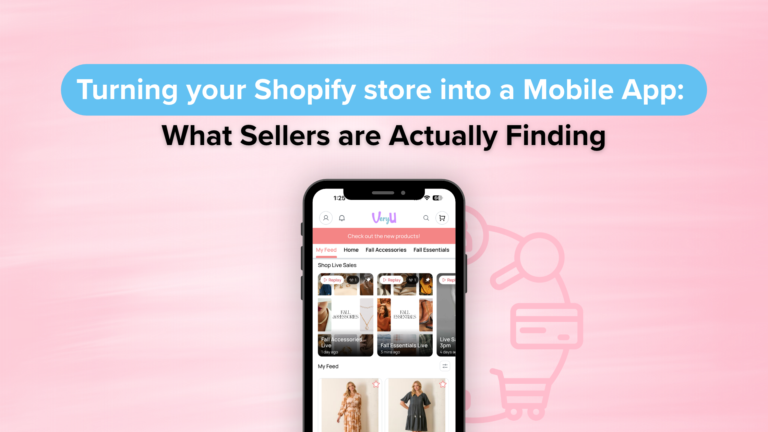
- Retention tools built in, not bolted on. A platform should make it easy to bring customers back, not just check them out once. 60% of first-time mobile app shoppers return to buy again, which means a branded mobile app is one of the highest-leverage retention tools an enterprise-level ecommerce platform can offer, provided it’s actually part of the core product rather than a third-party plugin.
- Native social selling and live commerce. Social platforms are where a lot of shoppers already spend their time, so an enterprise commerce platform that treats social as an afterthought is leaving revenue on the table. According to McKinsey, live commerce can achieve conversion rates up to ten times higher than conventional ecommerce. Platforms with native live selling built in, rather than bolted on through a third-party app, tend to see the biggest lift here.
- Automation that reduces manual work. 80% of successful online shops already use automation to handle tasks like invoicing, comment-to-cart conversion, and fulfillment. If a platform still requires a team member to manually process every order, it’s not built for enterprise scale, regardless of what the sales deck says.
- Actionable customer data and segmentation. A platform that can’t tell you who your repeat buyers are, what they bought last, or which segment is at risk of churning isn’t giving you enough to work with. Additionally, that data needs to be usable without a data science team to interpret it.
- A migration and onboarding process that doesn’t stall the business. Even the best scalable ecommerce platform is only as good as the transition into it. Ask vendors directly how long onboarding takes, what support looks like during the switch, and what happens to historical customer data.
Questions to Ask During Your Ecommerce Platform Evaluation
Before signing anything, run the vendor through these five questions. The answers reveal more than any feature comparison chart.
- Does it hold up on your highest-volume day? A platform that works fine on a normal Tuesday but buckles during a flash sale or a live show isn’t built for enterprise volume. Ask for real uptime data during peak traffic, not just an average.
- Can it unify inventory across web, mobile, and social in real time? If inventory updates lag by even a few minutes, you’ll oversell. That’s not a minor bug, it’s a trust problem with your customers.
- What does the migration timeline actually look like? Get a specific number of weeks, not “it depends.” Ask what happens to your historical orders, customer profiles, and loyalty data during the switch.
- Are retention and loyalty tools included, or will you need to buy them separately? Some platforms quote a lower base price, then the real cost shows up once you’ve added five retention apps to make up the gap.
- Can your current team run it without hiring more developers? A platform built for enterprise scale should reduce your team’s workload, not require a bigger one to operate it.
Where CommentSold Fits Into the Conversation
Most lists of enterprise ecommerce platforms lead with the same two or three names, and for large, high-SKU catalogs those are worth evaluating. However, for social-first, mid-size brands whose growth already runs through live selling and mobile audiences, CommentSold has earned a seat at that table too.
Rather than treating social selling as an add-on, CommentSold builds a branded mobile app directly into the platform, alongside native live selling and automated fulfillment and invoicing. That combination matters because it addresses three of the six criteria above in one system: retention through the mobile app, native social and live commerce, and automation that removes manual order processing. For brands migrating off a patchwork of Shopify plugins or a spreadsheet-and-DM operation, [seeing how live selling conversion compares to a traditional storefront](link to: [CommentSold blog post on live selling conversion rates]) is often the deciding factor.
None of this means CommentSold is the right fit for every enterprise. Brands running massive, non-social-driven catalogs may still need a different system. But if social and mobile are already where your customers spend their time, ruling CommentSold out of the conversation means skipping a platform built specifically for that kind of growth.
Frequently Asked Questions
What’s the difference between an enterprise ecommerce platform and a standard ecommerce platform? An enterprise ecommerce platform is built to handle higher order volume, multi-channel inventory, and deeper integrations than a standard platform, which is usually designed for a single storefront with lighter traffic. Enterprise systems also tend to include more built-in automation, retention tools, and support for complex fulfillment.
How long does it take to migrate to a new enterprise ecommerce platform? Migration timelines vary widely depending on catalog size and how much historical data needs to move, but most brands should expect anywhere from four to twelve weeks. Ask any vendor for a specific, written timeline rather than a general estimate.
Do enterprise ecommerce platforms include social selling and live shopping? Not all of them do, and that gap is becoming a bigger disadvantage as social platforms drive more first-touch discovery. Platforms built specifically around social and live commerce, like CommentSold, tend to see meaningfully higher conversion rates than those where social is bolted on through a third-party plugin.
How much does an enterprise ecommerce platform cost? Cost depends heavily on order volume, feature set, and whether retention and automation tools are included or sold separately. A lower base price can end up costing more once you’ve added the extra apps needed to match what a unified platform includes out of the box.
Is CommentSold considered an enterprise ecommerce platform? For social-first and mid-size brands scaling through live selling and mobile, yes. CommentSold combines unified inventory, a branded mobile app, live commerce, and automated fulfillment in one system, which is exactly the kind of consolidation growing brands look for when they outgrow a basic storefront.
Ready to See What an All-in-One Platform Looks Like?
Evaluating platforms is time-consuming enough without adding five extra apps to your stack just to close the gaps. If retention, live selling, and automation matter as much to your evaluation as raw processing power, see how CommentSold works and decide for yourself whether it belongs on your shortlist.