Coupon Codes That Protect Your Margins
You love the rush of a sold-out drop. What you do not love is watching a discount quietly eat the profit right out of it. For most small business owners, promotions are a double-edged sword. They pull hesitant shoppers over the line, yet a single sitewide code can wipe out the margin on your best sellers before you notice. Coupon codes should grow your revenue, not drain it. Fortunately, a smarter approach costs you nothing but a few thoughtful settings. Below, you will see how to reward your most loyal shoppers, shield your markdowns, and run promotions that feel generous while keeping your numbers healthy. Because a great deal should be a win for your shopper and for you.
Why Coupon Codes Quietly Eat Your Profit
Most discounts lose money because they are blunt instruments. A sitewide percentage code treats a full-price arrival and a clearance item exactly the same, so your shopper stacks a fresh discount on top of a markdown you already took. Coupon codes go sideways in a few predictable ways:
- They apply to sale items, doubling up on products you already marked down.
- They discount the whole collection when you only meant to move a few pieces.
- They calculate off the current sale price instead of retail, shrinking your take even further.
- They reward everyone equally, so your biggest fans get the same deal as a first-time bargain hunter.
The fix is not to stop discounting. In fact, strategic promotions are one of the most reliable ways to convert followers and reward loyalty. The fix is precision. When you control exactly what a code touches and who receives it, you keep the upside of a great offer without the margin leak. For a quick refresher on the math, it helps to understand your gross margin before you set a single discount.
5 Rules for Coupon Codes That Protect Profit
Want a simple framework? Follow these five rules and your coupon codes will start working for you instead of against you:
- Discount off retail price, not the current sale price. Apply a percentage or a flat dollar amount to the original retail number so a markdown and a coupon never compound.
- Exclude sale items in one click. Keep your promotions on full-price product so your planned markdowns stay balanced.
- Target specific products, not the whole collection. Choose the exact pieces you want to move rather than blanket-discounting everything.
- Reward exact VIP tiers, not everyone. Send your richest perks to your highest spenders and keep general offers separate.
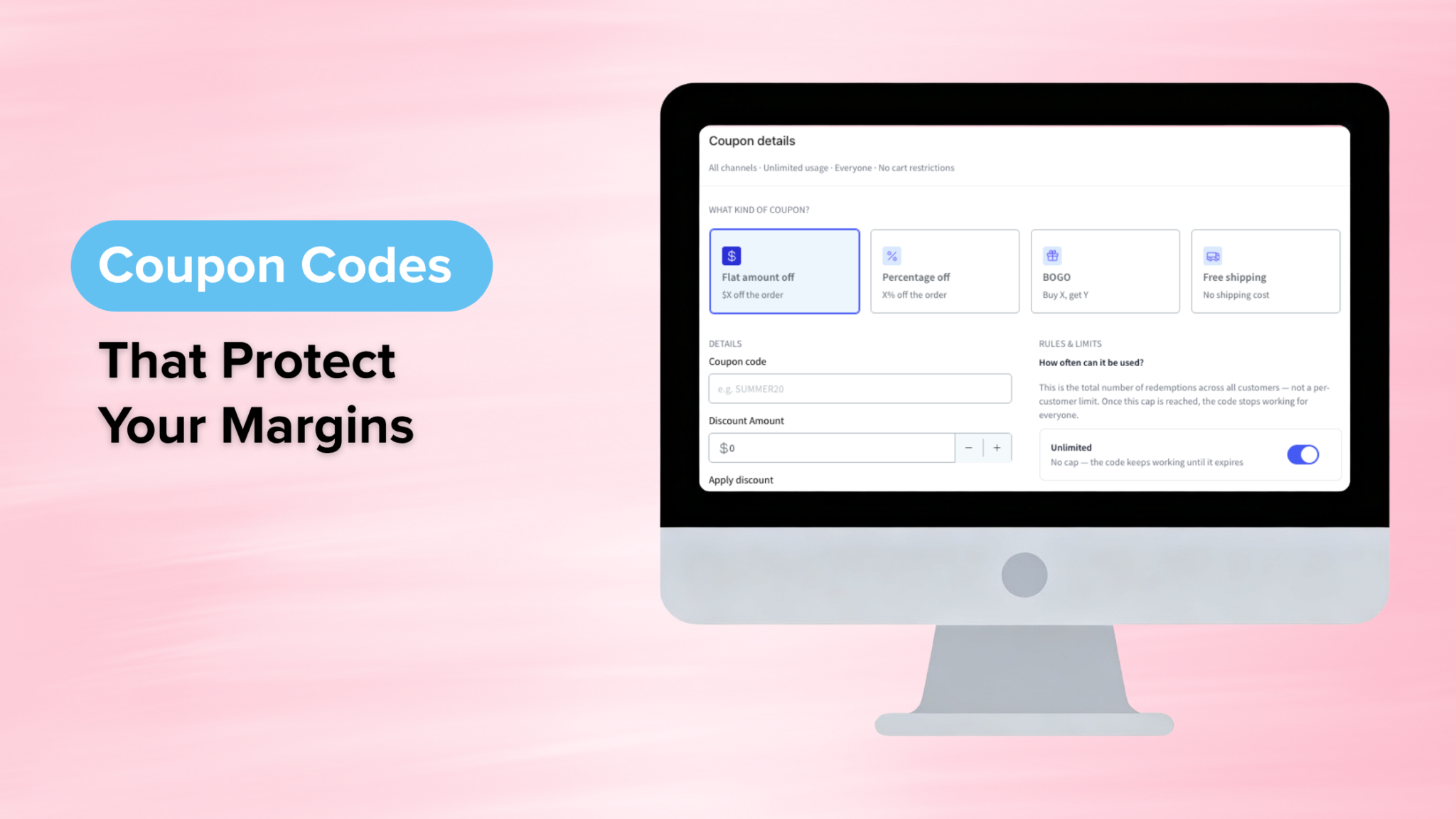
- Use flat-dollar BOGOs, not just percentages. A clean “$10 off your second item” often reads as more valuable than a vague percentage and is easier to control.
Each of these is a lever, and the best promotions pull two or three at once. A flat-dollar BOGO on a specific product line, excluded from sale items and reserved for your top VIP tier, is a targeted engine for repeat purchases rather than a margin sinkhole.
How to Set Up Coupon Codes That Reward Loyalty
Your best customers deserve better than a generic code. The most profitable coupon codes are the ones aimed at the shoppers already most likely to buy again, and that is where loyalty pays off. In fact, 60% of first-time mobile app shoppers return to buy again, so a perk pointed at that group compounds over time.
With CommentSold, you can zero in on a single VIP tier and hand your highest spenders perks reserved strictly for them. Better yet, you can set codes to auto-refresh every week, month, or year, so a “VIP Tuesday” or a monthly loyalty reward keeps engagement high without you rebuilding it each time. Additionally, per-item discounting applies savings to each qualifying item in the cart rather than capping the discount once per order, and flexible “Buy X, Get Y” offers let you design deals like Buy 2, Get 2. And with And/Or logic, you decide whether an offer applies to any chosen collection or product list, or strictly matches across every group.
That precision turns a one-time markdown into a retention habit. Rather than discounting to chase a single sale, you are building promotions that bring the same shoppers back on a rhythm you control.
Make Discounts Work Harder Without Working Harder
A promotion is only as good as your ability to run it under pressure. When a dozen codes are live before a big drop, you need to find the right one fast and manage it on the spot. A cleaner dashboard lets you filter your list by status, type, channel, date range, or usage threshold, so the code you need is a click away. Moreover, you can activate or deactivate any coupon straight from the list and reset usage as needed, all without touching your customers’ order history.
Transparency helps your shoppers too. Instead of one lump “coupon applied” line at checkout, the order summary now itemizes each coupon, showing the original price, the discount taken off that item, and the final price. As a result, shoppers see exactly what they are saving and where, which builds the kind of trust that turns a curious follower into a repeat buyer.
Frequently Asked Questions
How do small businesses create coupon codes without losing money? Start by discounting off the retail price rather than the current sale price, and exclude items that are already marked down. Then target specific products instead of your whole collection so a promotion only touches the inventory you actually want to move. These controls let you offer a real deal while keeping your planned margins intact.
What is the best coupon strategy for a small business? The best strategy is precision over volume. Reward your highest-spending VIP tier with perks reserved for them, use flat-dollar BOGOs to make the value obvious, and set codes to refresh on a schedule so loyal shoppers keep coming back. A few well-targeted coupon codes will almost always outperform one broad sitewide discount.
Can I stop a coupon from applying to sale items? Yes. In CommentSold you can exclude sale-priced items from any coupon with a single check, so your markdowns and your promotions never stack on top of each other.
Do coupon codes actually build customer loyalty? They can, when they are aimed at the right people. Perks tied to a specific VIP tier and refreshed on a weekly or monthly rhythm give your best customers a reason to return, which matters because repeat buyers drive the majority of sustainable growth.
Turn Your Next Promo Into Profit
You do not need to choose between generous deals and healthy margins. With the right controls, your coupon codes can reward loyalty, protect your best sellers, and keep shoppers coming back, all at the same time. If you are ready to run smarter promotions and turn one-time buyers into repeat customers, see how CommentSold works →.